
In the center of Mauritius, in the highlands of the Savanne district, Grand Bassin, also known as Ganga Talao, is the great sacred lake of Mauritius. The place brings together the deepest essence of the island: lush, humid nature, living temples, monumental statues, the scent of offerings, the silence of prayers and, around the lake, monkeys watching visitors with a very Mauritian curiosity.
For many travelers, Grand Bassin Mauritius is a memorable stop because it is neither a beach nor a simple viewpoint. People come here to understand an essential part of Mauritian culture, but also to breathe, walk slowly and take their time. Whether you are a believer, a landscape lover or simply curious, the visit calls for special attention: here, the beauty of the site is inseparable from the respect owed to a place of devotion.
Grand Bassin or Ganga Talao: why this lake is sacred
The history of Grand Bassin began in the 19th century with the arrival of the first Indian workers in Mauritius. Mainly Hindu, these immigrants brought with them their languages, their rituals, their festivals, their deities and their deep attachment to the Ganges, India’s sacred river. In Mauritius, far from their homeland, there was a need for a place of purification, contemplation and transmission.
Tradition tells that in 1897, the priest Shri Jhummon Giri Gosagne had a mystical vision: the waters of Grand Bassin were said to be connected to those of the Ganges. This legend gave the lake a sacred dimension and gradually transformed the site into a major pilgrimage place for the Mauritian Hindu community.
From the following year, pilgrims began traveling to Grand Bassin. The tradition grew stronger over time. In 1972, Swamis from India took part in a ceremony with Prime Minister Sir Seewoosagur Ramgoolam to mix water from the Ganges with that of Grand Bassin. This symbolic gesture strengthened the spiritual link between Ganga Talao and the sacred Indian river.
Today, the sacred lake of Mauritius is at once a place of memory, prayer and gathering. Families come here to lay flowers, burn incense, pour water, meditate or perform rituals in front of the temples that line the lake.
An atmosphere of temples, offerings and contemplation
The first impression at Grand Bassin is often one of profound calm. The lake lies in an ancient crater, surrounded by hills and vegetation. Depending on the weather in the highlands, the light can be clear and bright, or more misty, almost meditative. This variation gives the site a distinctive character, very different from the seaside image often associated with Mauritius.
Around the lake, several temples and shrines allow devotees to pray to different Hindu deities. Visitors can discreetly observe the ritual gestures: offerings of flowers and fruit, lamps, whispered prayers, the sound of bells, incense drifting through the air. These are simple and powerful moments, to be watched without intrusion.
To fully enjoy the visit, it is best to move slowly. Grand Bassin is not a site to be quickly “ticked off.” Its strength is understood by taking the time to walk around part of the lake, look at the reflections on the water, listen to the chants when there are any, and let devotees experience their moment without interrupting them.
The monumental statues of Shiva and Durga
The arrival at Grand Bassin is marked by imposing statues, visible from afar. The best known is the statue of Shiva, called Mangal Mahadev, which dominates the entrance to the site with a spectacular presence. It is about 33 meters tall and is one of the strongest visual landmarks of Ganga Talao.
A monumental statue of the goddess Durga has also been erected on the site. It too is about 33 meters tall, a height often associated with the sacred number of 108 feet in Hinduism. These works are not just photographic attractions: they contribute to the spiritual dimension of the place and recall the importance of Hindu devotion in Mauritian culture.
Facing these statues, it is natural to want to take photos. However, this should be done with restraint, avoiding inappropriate poses, excessive noise or intrusive shots when people are praying nearby.
Maha Shivaratri: the great pilgrimage to Grand Bassin
Grand Bassin becomes especially vibrant during the Maha festival Shivaratree, a celebration dedicated to the god Shiva. According to the Hindu calendar, the period can vary, generally between January and March. Before the festival, many pilgrims sometimes walk long distances across the island to the sacred lake.
The atmosphere then changes completely. The roads leading to Ganga Talao fill with groups of pilgrims dressed in white or subdued colors, carrying decorated kanwars, singing, praying and moving forward together. Entire families take part in this walk, in a spirit of fervor, effort and solidarity.
For a visitor, Maha Shivaratri is a powerful cultural experience, but it requires more preparation. Traffic may be changed, crowds can be large and access slower. If you wish to experience this period, check with reliable local sources, set off with flexibility and keep in mind that you are first and foremost witnessing a religious undertaking.
A natural richness in the highlands
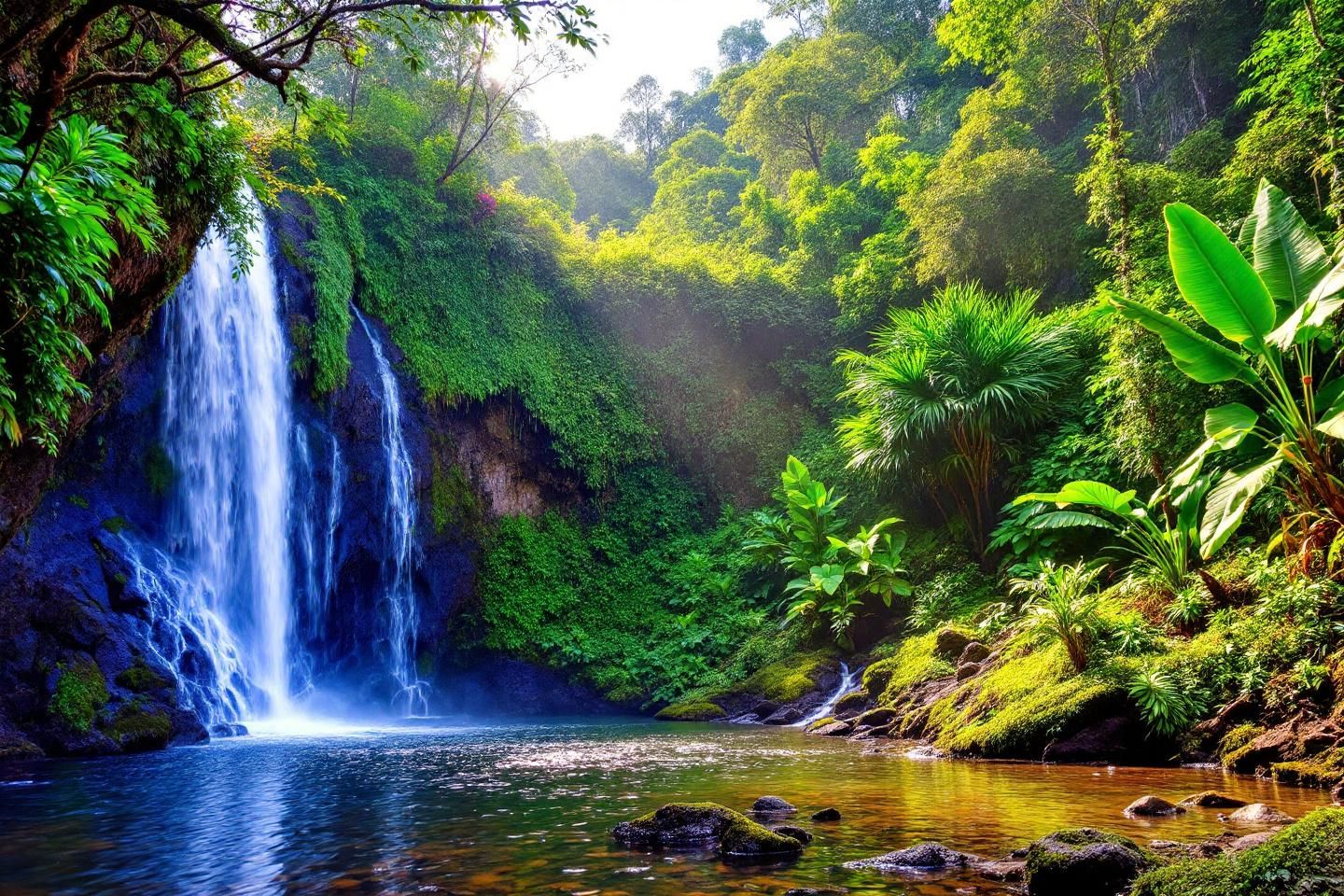
Beyond its spiritual importance, Grand Bassin stands out for its lush green surroundings. The lake lies at around 550 meters above sea level, in a region that is cooler and more humid than the coast. The roads leading there pass through landscapes of forest, gentle hills and plantations, with that distinctive atmosphere of the Mauritian highlands.
The vegetation around Grand Bassin is dense in places, with trees, ferns, tropical plants and a humidity that intensifies the scents of earth and leaves. Endemic plants can be seen in the island’s natural regions, and the surroundings of Grand Bassin are a reminder of how different the Mauritian mountains are from the lagoons.
Monkeys are also part of the scenery. They are often seen near the temples, on low walls, in the trees or around areas where offerings have been placed. They may seem amusing, but it is best to keep your distance, not feed them and keep an eye on bags, food and shiny objects. Their presence adds life to the site, without letting you forget that they are wild animals.
- Walk slowly around the lake to appreciate the views, the temples and the reflections on the water.
- Keep your belongings close to you when monkeys are present.
- Avoid touching offerings, altars and religious objects.
- Bring a light jacket: the weather changes quickly in the highlands.
How to visit Grand Bassin respectfully
Visiting the sacred lake of Mauritius does not require any particular religious knowledge, but it does call for considerate behavior. The most important thing is to remember that the site is above all a place of prayer. Visitors are generally welcome, provided they adopt a calm and respectful attitude.
Modest clothing is preferable, especially if you approach the temples: shoulders and knees covered, simple clothes, shoes that are easy to remove if you are asked to take them off before entering a sacred space. Speak softly, do not smoke in prayer areas, do not drop anything on the ground and avoid demonstrative gestures.
If a ceremony is taking place, stay back and observe without blocking the way. For photos, always ask permission before photographing a person up close. A smile, a step aside, a respectful silence often do more for the quality of the visit than any explanation.
| To do | To avoid |
|---|---|
| Wear modest, covering clothing | Enter a temple in beachwear |
| Observe rituals discreetly | Photograph devotees without permission |
| Remove your shoes if the place requires it | Touch altars or offerings |
| Keep your distance from the monkeys | Feed them or approach them for a photo |
Access and practical tips

Grand Bassin is accessible from different parts of the island. The easiest option is generally to come by car with a driver, by rental car or as part of an organized excursion. The site is located in the heights of the inland southwest; the journey is part of the experience, with roads that pass through cooler, more wooded and sometimes misty landscapes.
As the weather can change quickly at altitude, bring water, comfortable shoes and a light jacket. Even though the visit is not a difficult hike, you will be walking around places of worship, on areas that can sometimes be damp or busy. A relaxed pace is recommended.
Early morning often offers a more peaceful atmosphere. Late afternoon can be very beautiful if the light is soft, but you should take the return travel time into account. During Maha Shivaratri and on ceremony days, crowds can change the experience: check the conditions with your accommodation, a local guide or the official information available at the time of your stay.
Combining Grand Bassin with Chamarel, the tea route and the wild south
Grand Bassin fits very well into a day exploring the highlands and the southwest of Mauritius. From certain parts of the island, it is possible to combine it with Chamarel, its colored earth landscapes and viewpoints, or with a stop on the tea route to discover another side of Mauritian heritage.
This combination works particularly well if you enjoy days full of contrasts: spirituality in the morning by the lake, then lush green roads, plantations, waterfalls, villages and panoramas. The pace should remain reasonable. Grand Bassin deserves time; it is better to plan fewer stops and experience them fully than to multiply visits without soaking up the atmosphere of the places.
If you are staying in the north, especially around Grand Baie, plan for a full day to explore this part of the island. The journey is an opportunity to pass through several faces of Mauritius: urban areas, villages, fields, hills, forests and cooler uplands.
When to visit the sacred lake of Mauritius
The period of Maha Shivaratri is incomparable for feeling the spiritual power of Grand Bassin. This is when the site becomes a centre of collective devotion, with chants, prayers, pilgrims walking and offerings. For a calm first discovery, a visit outside the major religious days will often be more comfortable.
Outside the festival, Grand Bassin remains lively, but the atmosphere is more intimate. You will be able to better observe the temples, walk around the lake, listen to the sounds of the place and take the time to understand its role in Mauritian society.
| Time of visit | Experience to prioritise |
|---|---|
| Maha Shivaratri, according to the Hindu calendar | Respectful participation in a pilgrimage atmosphere, cultural immersion, observation of rituals |
| Morning outside major festivals | Peaceful visit, discreet photography, walk around the lake |
| Day combined with the high plateaus | Discovery of nature, wildlife observation, Chamarel or the tea route depending on your itinerary |
What to remember before going
Grand Bassin is not just a beautiful mountain lake. It is a sacred place, a major cultural landmark and a soothing natural setting. People come here to see, of course, but above all to feel: the fervour of the pilgrims, the presence of the statues, the freshness of the uplands, the movement of monkeys in the trees, the calm of the water.
For a successful visit, choose a time suited to your expectations, dress simply, respect religious practices and take your time. Grand Bassin will then offer you a deep discovery of Mauritius, far from clichés, as close as possible to its spiritual and natural soul.
Frequently asked questions
Are Grand Bassin and Ganga Talao the same place?
Yes. Grand Bassin is also called Ganga Talao. It is the sacred lake of Mauritius, a major Hindu pilgrimage site located in the high plateaus of the inland south-west.
Can you visit Grand Bassin if you are not Hindu?
Yes, visitors can discover the site, provided they respect its religious character. Modest clothing, calm behaviour and great discretion during prayers or ceremonies are recommended.
When does Maha Shivaratri take place at Grand Bassin?
The date varies according to the Hindu calendar, often between January and March. During this period, many pilgrims walk to Grand Bassin. It is best to check local information before planning your visit.
What can you visit with Grand Bassin on the same day?
Grand Bassin combines well with the high plateaus, Chamarel, certain stops on the tea route or the landscapes of the south-west. Ideally, keep a flexible itinerary so you can enjoy the lake without rushing.